
In keeping with my ideas about making a garden that works with, rather than against, nature I have been thinking about local conditions and also about what grows in this area. We live on the Fenland Edge which means that we are not as wet as the fens, however the low, flat, land is very prone to flooding. Currently the garden is waterlogged on account of the nature of the soil ( clay) and the very high water table. It doesn’t take much to make the grass (more moss than grass) spongy, in the bottom half of the garden especially, and I am concerned about my recently planted quince tree in particular that is currently standing in very wet ground.
There is a section of the evergreen hedge closest to the Busway that is dead and I presume this may be due to the earthworks as it was built and also the ongoing run off from the busway itself that pools at the lowest point on the edge of the garden.


In a couple of weeks time Steve is coming to cut these down and turn them into logs for our stove, getting rid of a rather nasty eye sore, but what ( if anything) to put in their place? Steve suggested willow and helpfully remarked that I could go and fetch some willow withies from the local surroundings and they would ‘strike’ easily making useful plants for the area.
A fine idea, not only plants for free, but plants that will enjoy the wet conditions. I could even coppice them for willow withies to make plant supports, not to mention harvest young branches to make screens and even possibly a ‘fedge’.
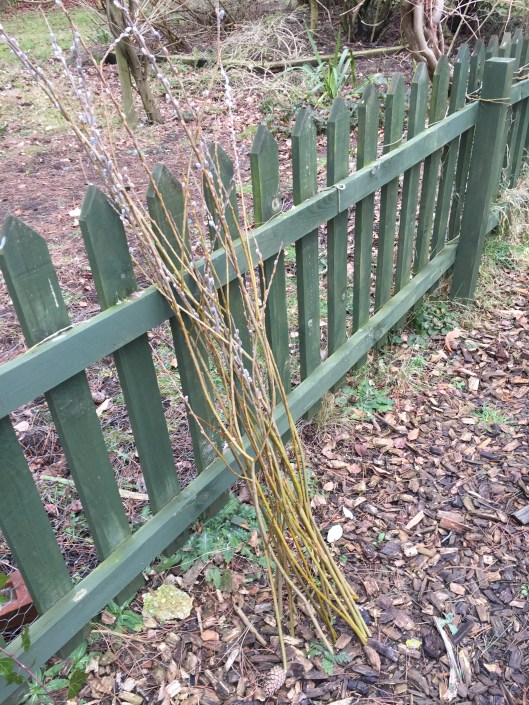
So today me and Lois went to the far side of the busway where there is a pond and a couple of old willow trees. I cut an armful of branches and have planted 21 stems in the vegetable garden to see how they go. I have included stems of varying lengths and sizes as an experiment, but if they perform as we expect I should be the proud owner of at least a dozen young trees by the summer, ready for planting in the autumn perhaps.
 easterneden