

The building project is in full swing and the garden is suffering- or is it me that is suffering watching the destruction of part of my ‘eden’? Of course, to put down foundations and to run services down the garden there is an inevitable quantity of digging, and with the wet winter weather and conditions special to this place (more later) it is incredibly messy and muddy.
I notice that the builders were very careful when digging up and re-laying the drive, so that we hardly knew they had been there, but nearer the site, where the features are natural and not man-made, they have been less attentive. Indeed when digging and laying the foundations (see above) they were pretty tidy. However, for many reasons, putting in the Biocell (cesspit) has been a challenge and the struggle has had a wider impact on the garden. I try not to be upset, knowing this is the nature of the process, but it is hard to hold faith in the return of the beautiful garden that I will create later.
Having asked the groundwork team to pile the excess soil in the garden, with raised earthworks to be fashioned in to a mound and windbreak, there has been even more extensive mud and mess, as they have been driving tractors up and down the middle of the garden, creating water filled ruts at least 2 feet deep in places. Oh my beautiful land- will you forgive us?
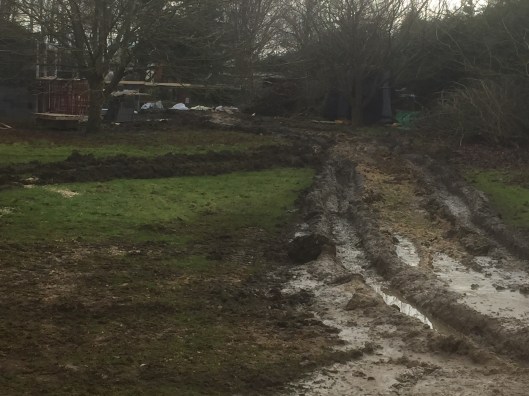
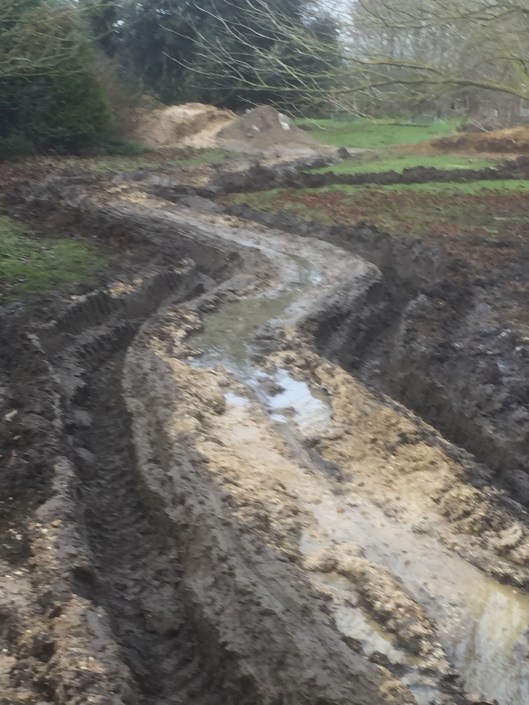
I can only smile at the irony of my wish to apply no-dig and permaculture principles in this garden, as it gets chewed to pieces and the ground is both churned and compacted. But I similarly know that nature will re-assert itself when the builders have gone and I will have the opportunity to manage the land it to create the garden that I want having been given a blank canvas or open ground. The groundwork team promise that when they finish they will smooth the site and I will be able to spread grass seed. I can only hope that the weather will help to establish a grassy surface before the Opening Party in June, otherwise there will be rock festival conditions in the garden!
A Lesson in Geology
What we have learnt about this land is that we have a fairly shallow silty soil above a layer of gravel, which is resting on a deep seam of basalt. The hole for the Biocell gave an opportunity to see this for myself
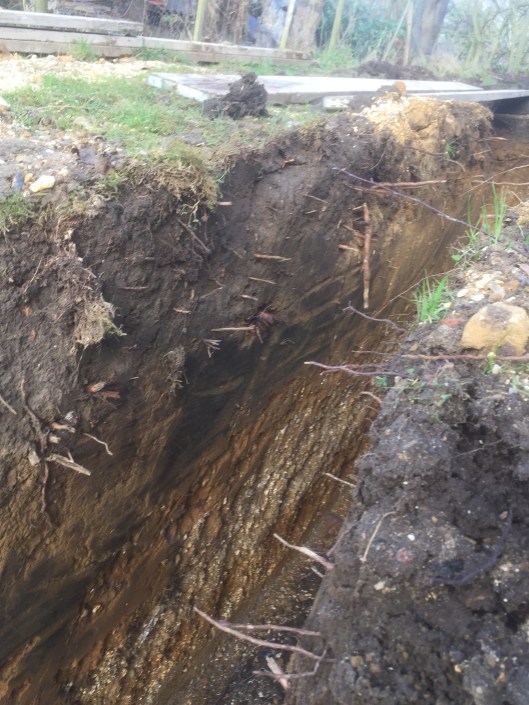
The silty top layer means that the moment it gets wet and disturbed it quickly becomes a sea of mud. It is like clay but less sticky, just slippery and unstable. Underneath is a layer of gravel, which means that the top layer can quickly dry out. However, beneath this is the layer of basalt that has caused the groundwork team no end of trouble with the Biocell. Basically, the basalt is extremely hard and the ground water sits on top of it. Once they were down 3M they hit water and had to pump continuously to get it dry enough for the concrete. In building terms it means that our cabin is sitting on a very stable base that is unlikely to be affected by tree roots and shrinkage in dry weather. What this means for the garden is that the high water table supports trees better than anything else, as once the roots get down to it they never dry out.
Kevin from the groundwork team said that basically this land used to be like a beach, mostly under shallow water. Basalt is igneous rock that comes from volcanic activity usually under water. Being that we are officially a ‘fen edge’ village, presumably we were on the edge of the large expanse of water that made up the fens before it was drained.
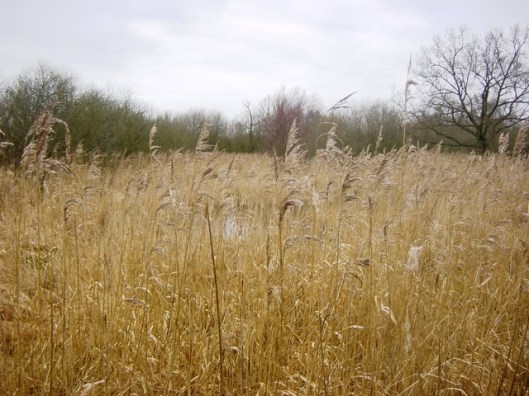
Given the high water table and the proneness to flooding I cam considering digging some ditches in the lower garden to act as drains, much as they have in the local fields. I could then plant with local sedges and willows to give a fenland effect, in keeping with the local environment. The wildlife would love it and it would be another interesting aspect to this garden.
At present however my thoughts for the area around the cabin are rather less ‘wild’. The cabin will have black clad walls, like an old style barn (but much sharper) and I intend to plant Himalayan birch trees for contrasting effect. Now that I know that trees will not disturb the foundations I can even go quite close. Then I shall underplant with stipa grasses and salvia or cat mint- both of which do well in the local conditions.

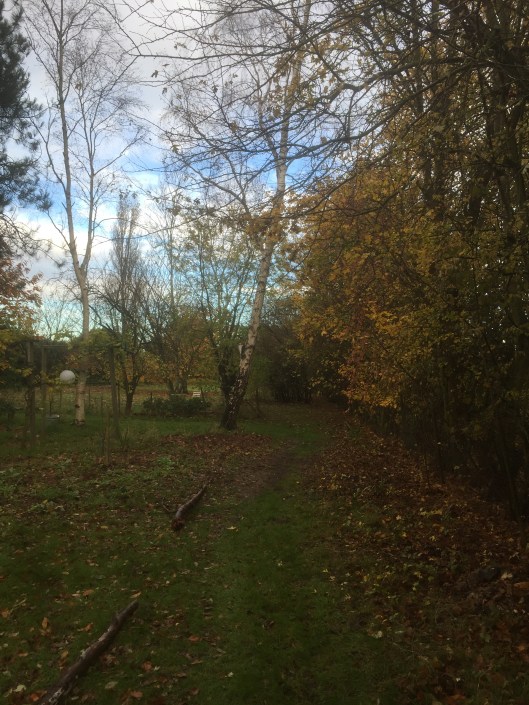
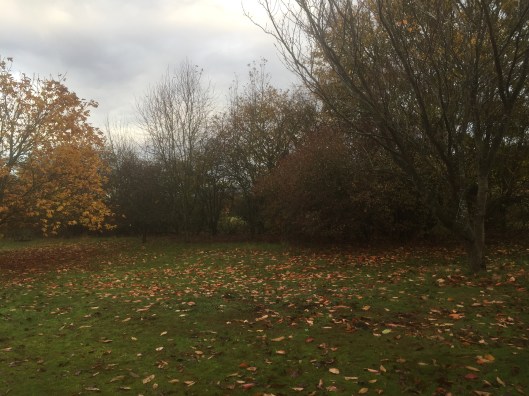
I also comfort myself with the fact that the snowdrops are coming up in the woods and I am also working to clear the greenhouse and vegetable garden. I focus my attention on the areas that I can work on, and keep thinking about and planning the new areas. Despite the mud and chaos this is actually a good time for such garden/building works. The groundwork team will probably be gone by the end of next week and soon I will be able to plant up in time for the rush of growth in the Spring. I can even take advantage of the availability of bare root trees and shrubs which are cheaper and establish more quickly. As I walk down the garden I try to turn my mind away from the mud and towards my gardening dreams for the future. As with life in general, holding faith in the future is part of gardening, as is trusting nature to re-assert itself to re-create a balanced ecosystem when man-made disruption has passed.
 easterneden