Collecting Plants, Collecting Ideas

The thing about having such a large garden is that there is so much space to be filled with plants and so much room for a variety of ideas. In my acre I can make many different gardens and there is room for as many plants as I like. In my previous garden the boundaries of space helped me to be a better editor; there was only really room for my favourites and only room for a few garden design ideas. As my Dad used to say it is the constraints that create good designs as it is the ways in which you work within the limitations that you have that give your creativity room to shine.

The luxury of a really big garden turns out to be something of a hindrance to good design. I have as many ideas in one day as I have space to realise the ideas and of course my main constraints are now time and money, and even these are only really constraints regarding time and money in the present- we will be here ( we hope) for a very long time so we have years and years of time. The trouble is what to do NOW, I have the long term in my mind’s eye but the ideas feel so big and I don’t really know where to start.

So what I find myself doing is collecting ideas and collecting plants with only a vague idea of what to do next. I know that I need to clear more ground and create the canvas for the development of the ideas , but which land to clear and indeed where should I start?

The plants are also starting to ‘back up’, I am buying bargains and also potting up and transplanting self seeded shrubs and perennials to fill the spaces that one day will be created and soon I will run out of space in what was my vegetable garden and I will run out of pots. I find myself reluctant to plant many of these shrubs in the ground in case they end up in the ‘wrong place’ and are too difficult to move.  I seem to do one of two things; clear away plants that I don’t want to create spaces and gather plants in other spaces to be transplanted later. What I need to do is to fix on a plan and stick to it…. hmmmmmm.

Plants collected

Box –hardwood cuttings have created 7 miniature box shrubs

Philadelphus Virginal–  being sold for £2 a plant in Tesco- not to be resisted

Deutzia Scabra- another plant for £2 at Tesco

Hebe– white flowered and evergreen

Daphne aureomarginata- a bargain at my local nursery

Hazel– self seeded in the garden and ready for my wildlife hedge

Bamboo- Naughtily smuggled back from France where it was spreading near the garden in Brittany.

Ideas collected 

A wildlife hedge ( double thickness at least) where the ‘rabbit proof fence’ currently is, dividing the top garden from the lower garden where the cabin will be.

A ‘secret’ garden in the middle garden around the pergola. I’m thinking of a secluded garden with white flowering shrubs and ground cover to be a place for meditation and privacy. My current ideas are to create two paths in a cross ( one under the wisteria pergola and the other at right angles). Then have quadrants with shrubs and ground cover. Perhaps ferns, white flowered perennials. At the centre of the cross a water feature and places to sit. Scented flowers and year round interest. Oh, and lots of birch trees perhaps for very dappled shade and white trunks in winter.

7 varieties of plants only in any one area which was what Monty Don said on a programme once and makes perfect sense and would get away from my currently ‘dotty’ style of planting. The trouble is this needs a plan and goes against my natural plant collecting instincts ….perhaps just a simpler palette would make up for breaking this rule.

A huge wildlife pond/lake to be seen from the house just beyond the lawn and perennial beds. To link with the local watery landscapes and provide visual interest. It needs to be big and bold and not too high maintenance.

The orchard underplanted as a separate place my ideal is the orchard as a space buzzing with bees and with a variety of soft fruits as well as the tree fruits. To achieve this I will need to get it fenced off to stop the rabbits and deer from eating everything. Rustic fencing with raspberries and blackberries as the boundary.

This is of course not the definitive list or a set of definitive ideas. I have to trust in the process I think and do a little bit at a time. This is how the garden changes, it feels incremental but over time big changes happen- like bringing up children ( apt on this Mothering Sunday)! Which in a sense if one of the reasons for this blog. I look back at the early photos of some areas of the garden that I took before we even moved here and so much has changed even though at the time the changes looked small on the weekends when they were effected.


Wildlife Gardening Inspiration

Last weekend I was inspired by a programme by Chris Packham called “The British  Garden: Life and Death on your Lawn”. Ok so a silly sensationalist title ( why do they do this?) for what turned out to be a rather interesting programme about the sheer number and variety of wildlife in a group of British suburban gardens in Hertfordshire.

The gardens were followed through the year, illustrating the changing seasons and highlighting key garden activity. It reminded me why I always loved natural history, from primary school nature tables through to my A level Biology field trip. The idea that all this activity and life is going on literally under our feet and all around us is both inspiring and magical to me.

The interesting conclusion of the programme was a count of the variety of wildlife in each garden, from the most manicured to the most over-grown and ‘wild’ and guess what? The garden with the biggest number and variety of wildlife was not the ‘wild’ garden as predicted but the ‘casually cultivated’ garden with fruit trees and areas of flower beds and more neglected areas where wild plants had invaded. They concluded that it was the variety of habitats, and especially the fact that there was something in flower pretty much throughout the year, that made all the difference.

I am inspired! the advice was to provide a variety of habitats with fruit trees, a pond flowers and wild areas. This is not going to be difficult for me to replicate. I am in the process of increasing the variety of ‘types’ of garden from the completely wild woodland at the end to the ‘cottage garden’, the ‘orchard’, the ‘water garden’ and a more secluded meditation garden in the middle with plenty of scented flowering shrubs and ferny ground cover. My aim in the garden is to have something flowering at all times of the year and of course in the end I want to have bees. So exciting!

Willows

In keeping with my ideas about making a garden that works with, rather than against, nature I have been thinking about local conditions and also about what grows in this area.  We live on the Fenland Edge which means that we are not as wet as the fens, however the low, flat, land is very prone to flooding. Currently the garden is waterlogged on account of the nature of the soil ( clay) and the very high water table. It doesn’t take much to make the grass (more moss than grass) spongy, in the bottom half of the garden especially, and I am concerned about my recently planted quince tree in particular that is currently standing in very wet ground.

There is a section of the evergreen hedge closest to the Busway that is dead and I presume this may be due to the earthworks as it was built and also the ongoing run off from the busway itself that pools at the lowest point on the edge of the garden.

In a couple of weeks time Steve is coming to cut these down and turn them into logs for our stove, getting rid of a rather  nasty eye sore, but what ( if anything) to put in their place? Steve suggested willow and helpfully remarked that I could go and fetch some willow withies from the local surroundings and they would ‘strike’ easily making useful plants for the area.

A fine idea, not only plants for free, but plants that will enjoy the wet conditions. I could even coppice them for willow withies to make plant supports, not to mention harvest young branches to make screens and even possibly a ‘fedge’.

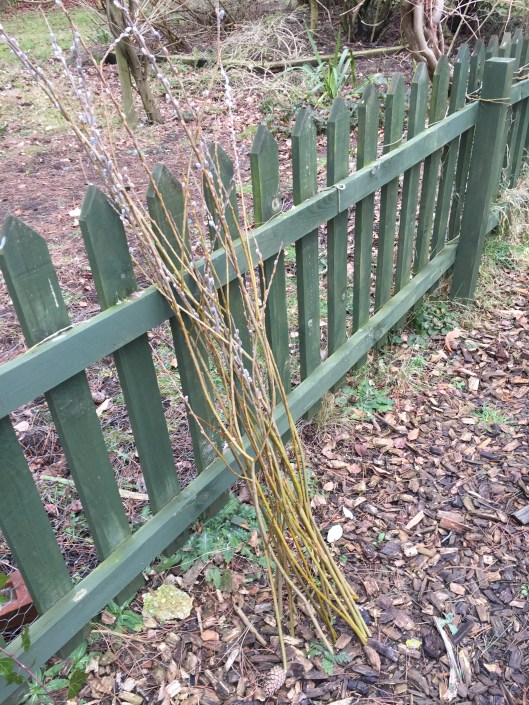
So today me and Lois went to the far side of the busway where there is a pond and a couple of old willow trees. I cut an armful of branches and have planted 21 stems in the vegetable garden to see how they go. I have included stems of varying lengths and sizes as an experiment, but if they perform as we expect I should be the proud owner of at least a dozen young trees by the summer, ready for planting in the autumn perhaps.

IMG_0963

Arctic greenhouse

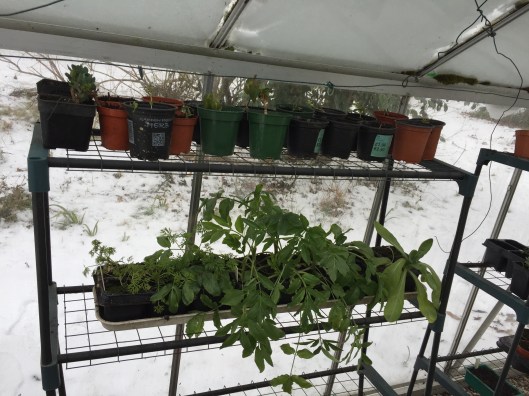
I was feeling so smug and proud of myself for getting ahead and sowing half-hardy annuals in the greenhouse in the autumn. A couple of weeks ago I cleaned the greenhouse glass and tidied and it was a picture of  organisation and productivity. I felt like one of those keen gardeners in the magazines who has everything organised and under-control . Go me- I am a serious gardener at last!IMG_0925

That was on the 17th February. Look, even salad greens to enjoy. I thought Spring was around the corner and I was ahead of the game.

So pride comes before a fall and if gardening teaches you one thing it is that we are not in control of nature- we are at it’s mercy. This was the situation yesterday…

IMG_0951

The plants were hit by the freezing conditions. For days the temperature did not rise above freezing . My carefully tended plants suddenly looked very sad as they flopped and collapsed. The salad leaves were limp and looking far from appetising.

Hopefully today’s thaw will be soon enough to allow them to bounce back. I will also get onto some more sowing, although some of the seedlings that I raised in my propagator are looking very sick and etiolated and were probably sown too soon. I should have really waited a bit.

So this is the thing really, you never know whether ‘getting ahead’ is worth the effort or whether your efforts will bear fruit. Gardening is not the sort of linear, logical activity where cause and effect follow on neatly from one another. More effort doesn’t always lead to more outcome and less effort is not always less rewarded. So one has to enjoy the process otherwise there is much potential for frustration and disappointment, as in the Buddhist idea to ‘act wholeheartedly,  but let go of the outcome’, it’s a lesson in humility as well as creativity. I can have all sorts of big ideas about how I want the garden to be and some of those will come through and work out and some of them won’t but I can still enjoy the process and delight in what I have created and nurtured. A constant lesson in ‘letting go’.

Update

This morning all is fine- phew! No apparent losses and the plants are gradually picking up. I shall water them tomorrow before we go away and hopefully they will be back on course. The lesson in ‘letting go’ has been postponed.

The Beast from the East

So, it was very cold and while there was less snow here than in some places, the garden had a good covering. Yesterday there was about 2 inches in the field area beyond the chestnut tree. It was really quite beautiful in the hazy grey light.

IMG_0954

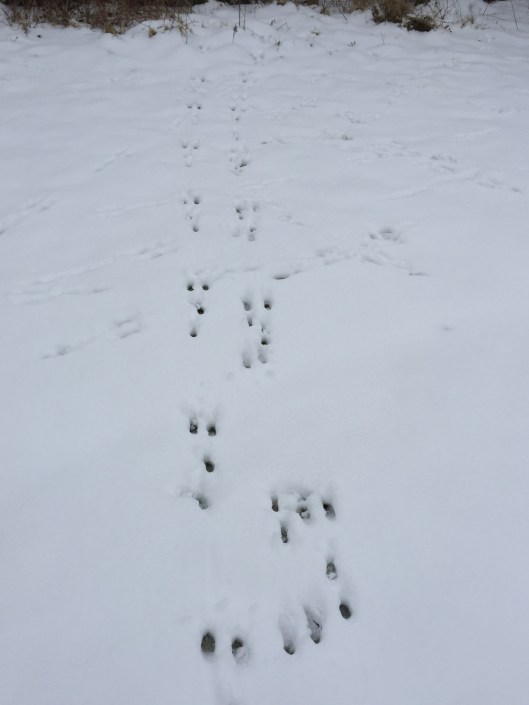
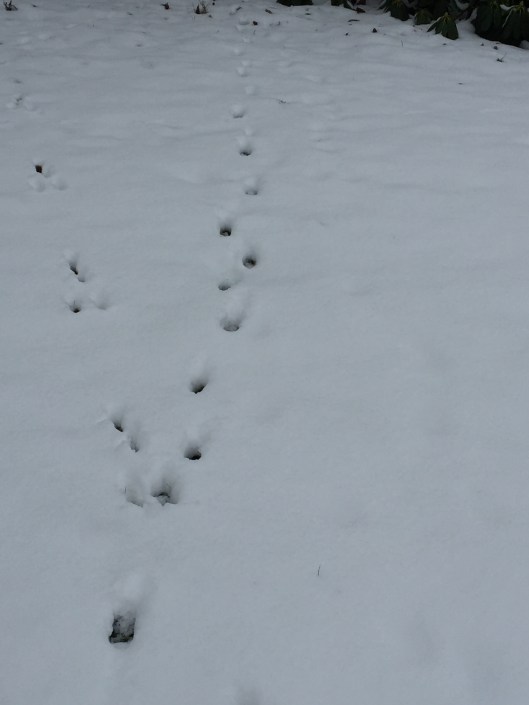
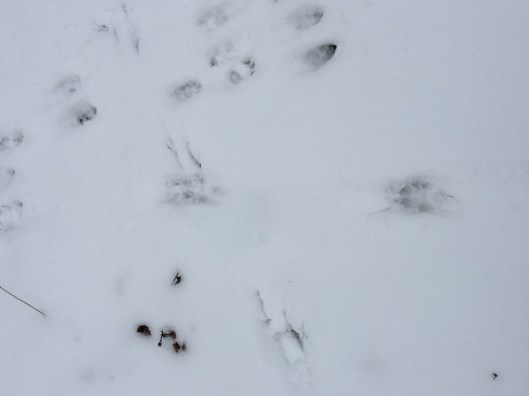
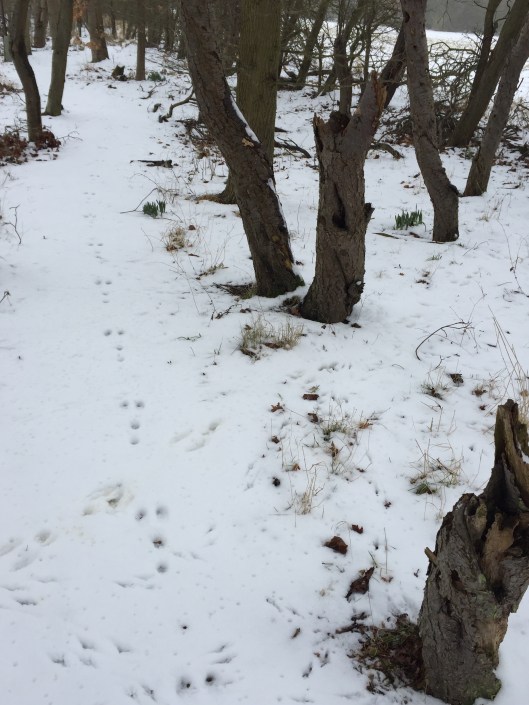
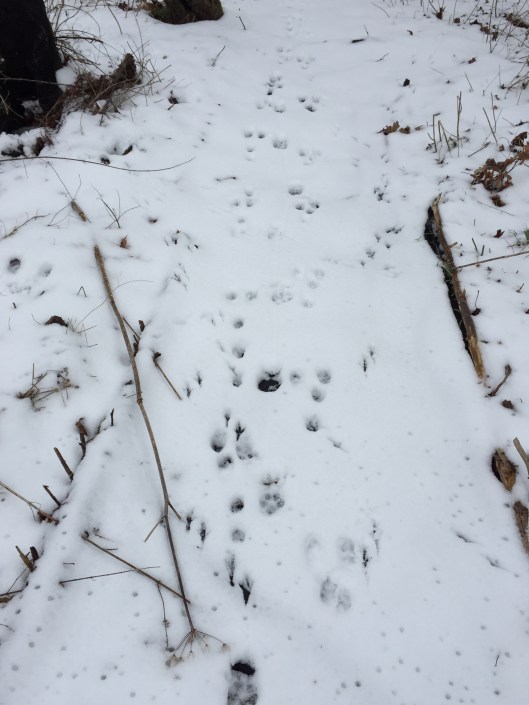
Walking in the snow in the garden also reminds me of the animals that share this space. There were rabbit tracks all over the garden, criss-crossing and even running in circles. Although I think this year, due to the cold, there were fewer tracks than in previous years.

IMG_0955

As well as the rabbits there were two fox tracks in the middle of the garden and badger tracks down in the woods. The foxes appear to travel fast across the garden with foot prints at some distance from one another, while the badgers ‘potter around’ in the orchard.

IMG_0953

IMG_0957

I was tickled to see that the rabbits and badger use the path we cleared through the woods; all very civilised!

IMG_0959IMG_0958

Snow days in the garden meant that there was no gardening to do at the weekend forcing me to do the indoor jobs like mending that I usually leave in favour of being outside. Now it is thawing I feel the urge to be outside again but after a lull in activity I am not sure where to start again. There is so much to do and with Spring on it’s way there is a growing sense of urgency that I am trying to stave off in my new attitude of approaching the garden as a ‘meditation’ rather than a ‘to do list’. I’m not really sure how to be more measured when it comes to Spring, as I usually get such a surge of energy that it almost feels like mania. However, for the time being the slushy snowy ground and the cold temperatures are keeping me inside.

The sun is still shining- above the clouds.

And so the brief Spring-like interlude comes to an end with a day of low cloud and drizzle. The weather really affects me, and while I try to remember that the sun is still shining above the cloud, somehow I still cannot throw off the feeling of sadness and heaviness that this sort of day brings to my mood.

For the last few days I had the opportunity to work in the garden and had the real pleasure of plenty of sun, and the bird-song that goes with it. I was busy and productive, but also took the time to just sit and enjoy the garden and the feeling of joy and ‘aliveness’ that I was experiencing.

Today is the flip-side to that, the other side of the coin that makes those sorts of days so very precious because they do not occur all the time. Today I am back at work and I also have to take my leave of the garden and work away for the rest of the week. I feel a sadness about leaving the garden that I feel when saying goodbye to someone I love- or perhaps it is more the sadness of knowing that for every day of joy and pleasure in the garden there are the days when I cannot be there and have to focus elsewhere. I actually know that I will enjoy London when I get there and will spend time  with people that I like (and love) doing things that are stimulating, interesting and important. But right now I am feeling the ache of having to let go of ‘home’ and go out into the world again.

I also do know that in life I need the balance between the peace and quiet of the garden and solitary activity, and the excitement and stimulation of getting out in the world, meeting people, sharing ideas and being socially engaged. Losing either would be a significant loss and I do know that too long away from ‘society’ has a bad effect on me making me restless and frustrated. It’s just that sometimes the balance feels too much tipped one way or the other and I certainly feel the need of more gardening time than I have been able to manage recently with all the working away.

So life goes in cycles, just as the garden does and the changes in weather are all necessary to make life, and the garden into a satisfying whole. We need the sun and we also need the rain, and life must be lived in a balance cycling between the different times, activates and states. I know this in my mind, but this morning I don’t feel it in my heart and I am longing for more sunny days.

Today I will walk to the end of the garden, visit the trees that I planted and soak in the atmosphere and be grateful for what I have and remember that it will all still be here ( with some subtle changes as the garden and wildlife do their thing) when I return at the weekend and I will love it all the more then for the absence.


Laissez Faire reaps rewards.

I have discovered in the last three years that my tendency to be less than assiduous in the garden often pays dividends in terms of self-seeding and natural plant propagation.

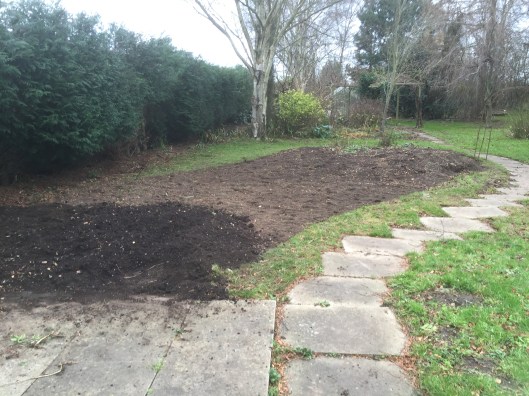
The second Winter that we were here I dug out a brand new flower bed intending to fill it with perennials, shrubs and bulbs.

2015-12-06 11.40.03

The hard work was in the creation and the first year the weeding was a nightmare with nettles and field bindweed trying to take control. However, I also had to pull out barrow-fulls of oriental poppies that came up in year one and overwhelmed my carefully selected and planted perennials.

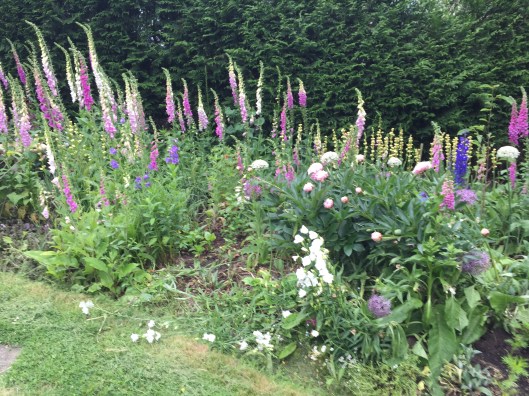
In year two it was the foxgloves that made a big display, and what a wonderful sight that was ( until they all went over in July leaving empty patches).

IMG_0552


This year it is Lychnis that has self seeded all over the beds and I am very pleased. Last year they were really good performers with deep crimson flowers and silver foliage, I’m happy to welcome them back. I also think that those flowers that self-seed tend to do better because they grow in conditions that suit them. In fact the Lychnis should do well in the sun backed end of the bed where the soil is poor and stoney and the fact that it is higher than surrounding areas means that it dries out very fast.

In the autumn I was very busy and failed to trim back some of the perennials and actually only really cut back what was offensive to the eye. I left the penstemons as they stayed ‘evergreen’ and looked quite healthy. The only problem was that they drooped and fell all over the place. This week in the spirit of getting on top of things I went to cut them back and found that they had spontaneously layered, striking roots from some of the stems. Hey presto I now have 10 extra penstemon plants without the bother of lifting and dividing.

So I conclude that often less is more, even in the parts of the garden, like the beds near to the house that I feel I should give most attention to. Laziness pays off and there is little merit in constant clearing and weeding. I now aim to think of weeding as an infrequent activity that I do to simply make sure that plants that I do want are not overwhelmed by those that I don’t- in fact don’t even get me started on the iris foetidissima that comes up all over the garden- I loathe it and it has to go whenever I get to it. Some weeds I can decide are wild flowers, some remain weeds.

The best time to plant a tree was 20 years ago…

…the second best time is now.

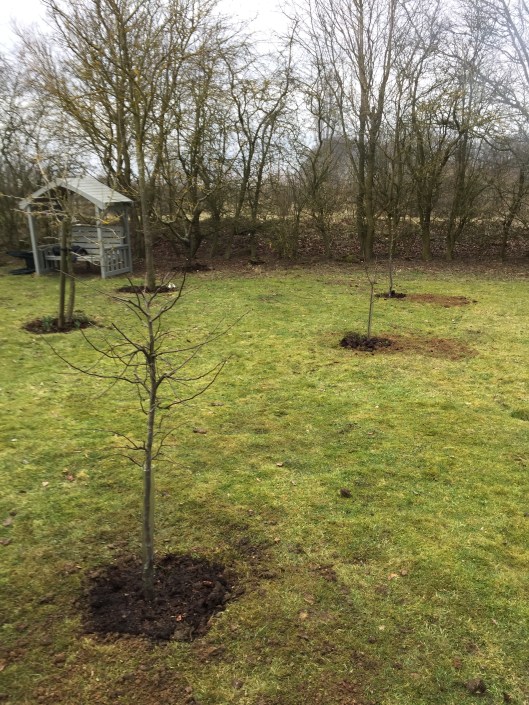
Apparently an old Chinese proverb told to me by my brother David Kesteven. Wonderful advice that I have taken up today when I planted 4 new trees; Two Victoria Plums, a Serbian Gold Quince and a Bramley Seedling. I have been renovating the orchard and wanted to extend it both in size and variety of fruits.

IMG_0943


I am so grateful to my predessesor Stuart who, probably about 20 years ago, started the orchard of around 20 trees ( William Pear, Comice Pear, Conference Pear, Katy Apple, Cox’s Orange Seedling Apple, Spartan Apple, a Greengage, a Cherry and two trees with orange small fruits that I cannot identify).

The trees were quite overgrown and the orchard was over-run with nettles. Some of the trees were producing no fruits or the fruit was of poor quality. I have worked through, weeding around the bases of the trees and adding some underplanting (mainly daffodils which the rabbits don’t eat). Today I added some tete-a-tete daffodils, thyme and chives which I think may be unpalatable to the rodents ( although having said this they ate the lavender that I planted before).

My aim is to have an orchard that is both productive and a lovely place to be. We put our arbour down there (bought with wedding present tokens) and it is my favourite sitting place. I go there to find some peace and it is a good distance from the house so that it is far enough away to have it’s own atmosphere. In the Spring it smells wonderful with the blossoms and in the Summer it smells wonderful with the fruits. If I can find underplanting that the rabbits won’t eat, all the better. My ideal is an orchard humming with bees and the right underplanting can potentially keep coddling moths away from the fruit without the use of chemicals.

One day I plan to have a beehive down there to complete the scene and to increase productivity. I also wonder about fencing it in to keep the animals off the fruit ( I suspect deer stole my pears last Autumn when we were away!) and to provide a framework for soft fruits like raspberries and gooseberries.

The orchard is definitely my happy place.


New Year, New Intention

It’s the Chinese New Year this weekend and recently was the old Pagan celebration of Imbolc, which is a time of year when the rumination and hibernation of the deep mid-winter become the intention and initial actions of the very early Spring. Imbolc was the time to name and recognise the resolutions of the New Year and to clear out the old to make room for the new.

I realised that I wanted to change my relationship with the garden, and also the nature of this blog, to reflect a new change in attitude and an exploration of the garden that takes in both external and internal dimensions of what it means to create and sustain this garden. I have been reading, reflecting and walking in my garden and questioning my attitudes and feelings about it and I want to use this space to explore further.

When I created this blog I was initially thinking about having a physical record of the changes that were occurring in the garden, seasonally as I got to know it, and also the changes that I was intentionally making. I was aware that the garden was a huge project and I wanted to create a progress record so that I could look back and see the changes that were often too incremental to notice at the time. However, at the risk of sounding trite the experience of gardening here has changed my attitude to the whole project; it has changed me as much as I have changed it.

So what have I learnt that has changed my approach?

The garden is too big to approach the task of gardening as I had in my previous garden.

There is simply no way that I can keep up with all that I would like to do in the time that I have. I cannot make flower beds the size that I would like them and then keep them free of weeds. If I did nothing but weeding every weekend I would still not beat the weeds, and anyway that is no fun. Ideas of neatness and the creation of a ‘show garden’ are not realistic.

That nature is a powerful force that cannot be controlled.

For a start there is simply so much wild-life. I love the animals that live in and around my garden and seeing badgers, foxes, rabbits and even deer gives us all considerable pleasure. Attempts by the previous owner to keep them out were only partially successful and the rabbits will eat anything and the badgers will dig holes everywhere. The deer nibble the tips of shrubs and the bark of trees. I could spend an enormous amount of time, effort and money to fence them out, but then I wouldn’t have the joy of seeing them and knowing that we live close to one another in a ( sort of) harmony.

Then there are the stinging nettles which grow everywhere in the margins of the garden and other invasive plants that constantly attempt to invade the space. I could spend every weekend pulling up nettles and digging out thistles and still never get rid of them. Which again would be no fun and would also (especially in the case of the nettles ) reduce the habitats of many insects.

That I get as much joy from walking in the woods at the end of the garden, where I do virtually nothing to cultivate and control, as I do from looking at the flower beds near to the house.

The woods are constantly changing and at present are full of snowdrops that are spreading of their own accord. I do nothing to interfere with nature in the woods and I am rewarded every year with a beautiful display. It is as though I am getting a beautiful garden ‘free’.

There is also a quality of beauty in the woods that is about being in nature in the raw that I go to again and again for peace and reassurance. As Lao Tse said ” Nature doesn’t hurry , but everything gets done”.

So what is my new intention for the garden?

To work with nature and not against it.

The idea is that anything that I do change in the garden  should not create extra work. Of course there will always be areas that are more labour intensive, such as the perennial beds and the cut flower/veg garden, but in the main I want to focus on the planting of trees and shrubs and ground cover and avoid the sorts of planting schemes that need constant maintenance.

 To create a garden that is a wild-life refuge.

I want to welcome animals and birds into the garden and if anything increase the number and diversity of the garden visitors. If the garden is to be a sanctuary for humans I also want it to be a sanctuary for animals.

To create a sanctuary for me and others.

Since starting to explore mediation and mindfulness I have increasingly experienced the garden as a potential sanctuary and space for peace and reflection. It is where I go when I am stressed and it is where I can sit and enjoy the beauty of nature. I want to increase this aspect of the garden and use it as a vehicle for my spiritual journey.

That gardening should be about nurture not about struggle.

So often gardening is approached as though it is an exercise in ‘taming’ nature and imposing control on a wayward piece of land. This can lead to gardening that is more akin to ‘housework’ than anything else. I really do not want gardening to feel like just another job on my to do list , an exercise in ‘being busy’. I want my experience of gardening to be more creative and liberating. Yes, there will be big projects and big changes, but I want them to feel gentle and as though I am restoring the garden to nature rather than fighting it.

That engaging with the garden can be part of a deeper connection with nature and the seasons and a tool for emotional integration and growth. 

Ok so that all sounds a bit new-agey but my experience is that since we have been here at the Old Railway Tavern I have felt more in touch with the seasons and the process of continual and cyclical change than ever before. The garden carries on and does its thing regardless of  what is happening in my life, but it also reflects my life too and the experience of the world that is connected to the seasons and weather. The garden is the space where I can re-connect with something more elemental in my experience and I want to use it increasingly as a place of refuge and for meditation.

So the nature of this blog is going to change to include more reflective material and ideas from my reading and other internal explorations. More like a nature journal than a garden record. If you are interested do keep reading and I’ll try to make comments more regularly, and I would of course welcome any comments from my readers. let’s talk about gardens and gardening as part of our experience of nature and personal growth, as well as appreciating the practical stuff of plants and plans.


Front garden makeover

“Necessity is the father of invention” is what my Dad often says and so hearing that I was not allowed to ‘cultivate’ the front garden because it essentially is a verge and belongs to the Local Authority sent me back to the drawing board. I figured that I could cultivate the strip that is right against the house and also any land to the side around the driveway.

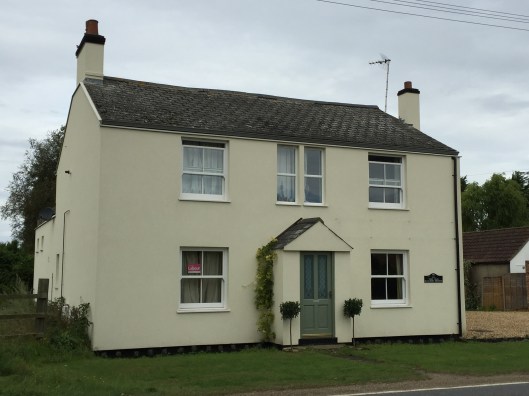
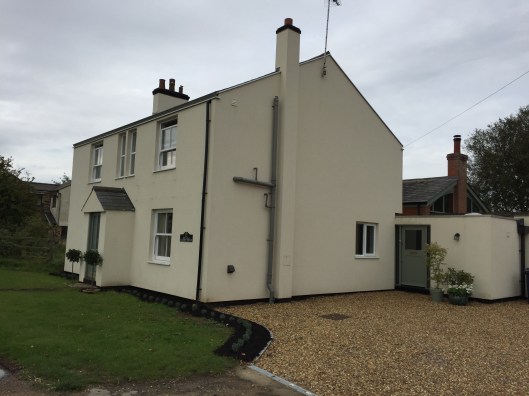
I wanted something neat, formal and easy to maintain, as because it is by a very busy main road,it is not the most relaxing place to do gardening. I settled on a lavender hedge (planted through a weed proof membrane) and a bed on the south facing wall with a fig tree against it and seasonal bedding, along with decorative pots by the entrance.

Happily I recently won a pair of lollipop bay trees in a competition run by my local nursery. This was a real delight as I had lost all my bay trees when I moved house and we also took out a large bay tree that was half dead and over grown.

I am really pleased with the formal neat effect. Quite unlike the back garden.

IMG_0613IMG_0616